
 Wetlands are some of the world’s most vital yet threatened ecosystems, crucial for biodiversity, water quality and climate resilience; 40% of the world’s plants and animals depend on them. Yet since 1970, 35% of our wetlands have disappeared between 1970 and 2015.
The Wildfowl and Wetlands Trust (WWT) has been pioneering conservation for more than 75 years, and through the Wetland Learning Hub, it is now sharing this knowledge and expertise with conservationists worldwide.
The Challenge
With more than 75 years of evidence-based conservation expertise, WWT’s vision is a world where healthy wetlands thrive, support biodiversity and enrich lives. The organisation aims to share their knowledge with conservation professionals around the world, especially in regions where wetlands are under intense pressure and where training opportunities are limited. Key targets for WWT include:
- Create and restore 100,000 hectares of wetlands in the UK by 2050.
- Support locally-led action to improve 1 million hectares of wetlands globally in key biodiversity hotspots.
- Inspire and equip 25,000 conservationists with the skills to deliver impactful wetland conservation on the ground.
WWT is an international organisation partner to the Ramsar Convention, which is focused on wetland conservation through local, national and international cooperation.
With funding from the UK Government’s Darwin Initiative, WWT set out to address a lack of structured training for conservationists working on wetlands by:
- Improving conservation knowledge within organisations globally
- Sharing best practice globally, not just within one region
- Developing wider understanding of wetland management strategies
While initially focused on early-career conservationists, it quickly became clear that demand was broader, including government officials, NGOs, civil society staff, academics, researchers and private-sector practitioners.
The challenge here was scale: how do you deliver structured training across regions, organisations, career stages and languages while still creating a sense of cohort, community and real-world application?
The Solution
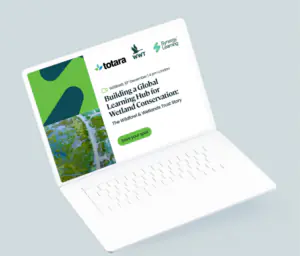
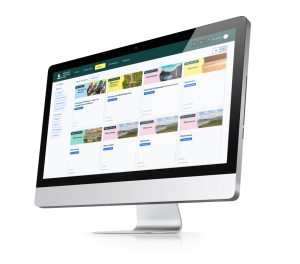
To help the organisation achieve these goals, Synergy Learning was tasked with creating the Wetland Learning Hub. This would be the organisation’s first learning management system, powered by Totara LMS, targeting wetland professionals working for local and international non-governmental organisations and charities, as well as government agencies, NGOs, civil society staff, academics, researchers and private-sector practitioners.
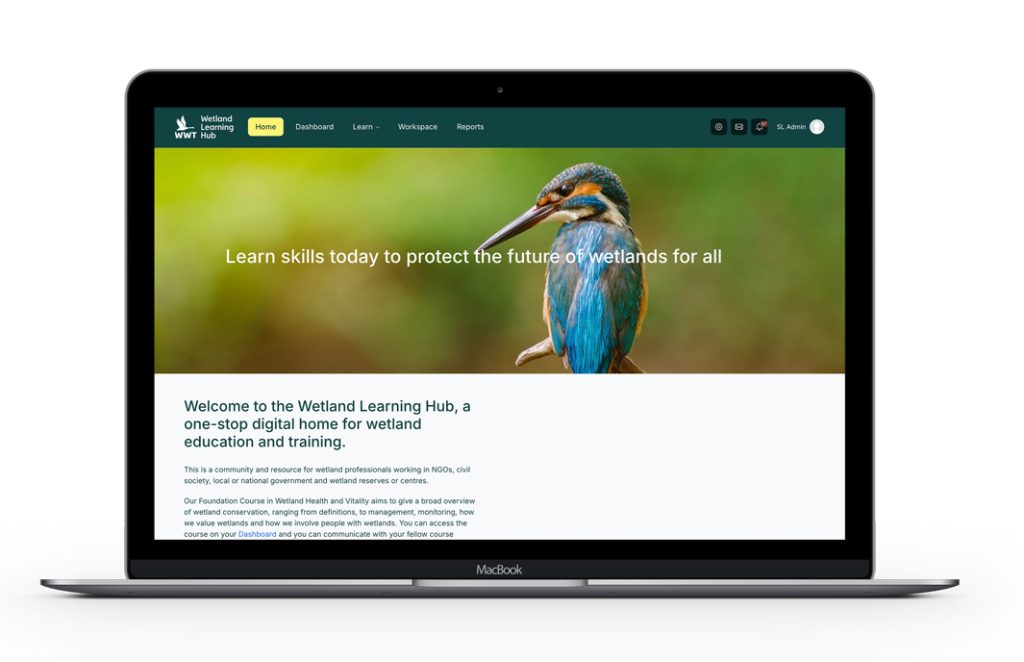
Structured learning pathways
The flagship programme is delivered as a pathway via the LMS, guiding learners through four key modules:
- Introduction to wetlands and wetland ecosystems
- Socioeconomic and cultural values of wetlands
- Wetland management and monitoring
- CEPA (Communication, Education, Participation, Awareness)
Learners complete modules over a set study period (trialled at 14 weeks, then refined to 10 weeks to increase completion rates through a tighter deadline), supported by recommended due dates and automated reminders in Totara LMS.
Engaging learning content that transfers to the role
Each module blends interactive content and practical application to boost learning transfer. This content includes:
- H5P interactive video lectures with in-video questions to maintain engagement and reinforce understanding.
 Practice quizzes.
- Topic-level feedback polls to continually improve the learning content.
- A practical assignment at the end of each module, requiring learners to apply their knowledge to a wetland of their choice and share outputs in
- Totara Workspace discussions for peer and facilitator feedback.
- A final graded quiz (80% pass mark), leading to a customised certificate within the LMS and an invitation to a Linkedin alumni group to keep the conversation going post-learning.
Live learning with streamlined management
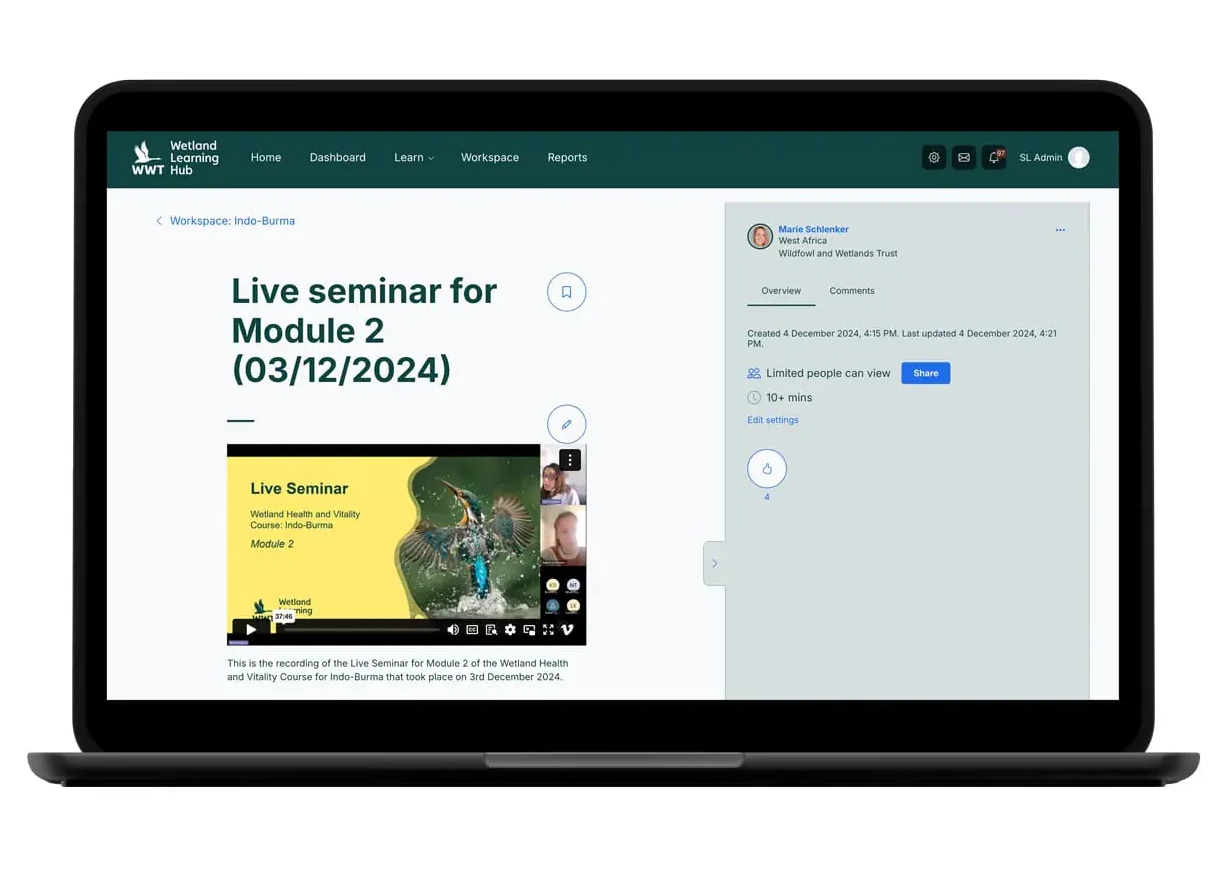
WWT uses seminars in Totara LMS to manage registrations and attendance for live Q&A sessions and webinars. This supports peer learning and regionally relevant discussion, while giving the learning and development team at WWT the tracking needed to manage participation and progression.
Social learning at a global scale
WWT used Totara Workspaces as the engine of social learning within the Wetland Learning Hub. Workspaces became the focal point for:
- Introductions, questions, announcements and reminders
- Learner-led discussion, peer feedback and resource sharing
- A continuously expanding library of additional learning materials and recorded seminars
- Language-specific spaces to remove barriers and increase participation
 Multilingual delivery for equitable access
The Wetland Hub has enabled courses to be delivered in English, French and Portuguese for regional rollouts in Indo-Burma, Madagascar and West Africa, with the ability to add further languages for more regions as the programme expands.
The Result
From the outset, WWT designed learning around real-world practice and behaviour change. The programme requires learners to apply frameworks and tools to wetlands they know, then learn from peers tackling different contexts across countries and ecosystems.
100% positive learning impact
WWT intentionally avoided “top-down” learning in favour of a social learning approach that has seen a staggering 100% praise for positive learning impact from learners; all respondents to a post-course survey reported a positive impact on their knowledge of wetland conservation.
Reduced support burden through peer knowledge sharing
Workspaces have helped learners share local expertise and solve problems together, including “helper” participants who answer technical and content questions. This has reduced support burden and strengthened the learning community for WWT.
Driving conservation efforts at scale
Despite being WWT’s first LMS, the Wetland Learning Hub has delivered strong results already:
192 learners have successfully completed the online course across three regions (Indo-Burma, West Africa and Madagascar), plus a further 50 who attended in-depth in-person sessions.
Learners came from government bodies, NGOs, civil society, academia and the private sector, reflecting strong cross-sector demand for structured wetland training.
79% shared learning with colleagues and within their organisations, multiplying the effect beyond direct participants.
In less than two years, WWT has successfully used the Totara LMS to build a multilingual learning community, improved conservation capability across sectors and created a scalable model that spreads best practice globally, turning digital learning into tangible environmental action.
I’m very happy. Synergy Learning have been really helpful. It was nice to have consulting calls at the start and opportunities to ask questions. All of my queries were answered very quickly.
Project Officer
Customer
Connected Partner
Customer
Region
United Kingdom
Sectors
Nonprofit
Industry Sizes
Small
Solutions
Learn
Connected Partner