

Think beyond employee training for a moment. How do you make sure your customers, partners, suppliers, and contractors all have the knowledge they need to work effectively with your organisation?
Extended enterprise learning helps organisations deliver targeted training to these external audiences through a structured, scalable approach. Platforms such as Totara provide the flexibility to support these learning programmes.
In this article, with the help of our platinum partner, Synergy Learning, we’ll explore what extended enterprise learning is, the value it delivers, and how to build an effective strategy using Totara.
What is extended enterprise learning?
Extended enterprise learning is the delivery of training to learners outside of an organisation’s core workforce. Where traditional training focuses on employees, extended enterprise training offers learning to external stakeholders.
It extends an organisation’s learning and development strategy across its wider business ecosystem, bringing external training into the same connected framework as internal training. Rather than managing this external training through one-off programmes or separate systems, organisations can coordinate content, access, progress, certifications and reporting in one place.
Extended enterprise learning vs traditional training
Traditional workplace training is primarily aimed at an organisation’s internal employees. This means the core audience typically shares the same systems. While specific learning needs and content may be tailored by role or department, it’s relatively straightforward to deliver and track training through a single learning environment.
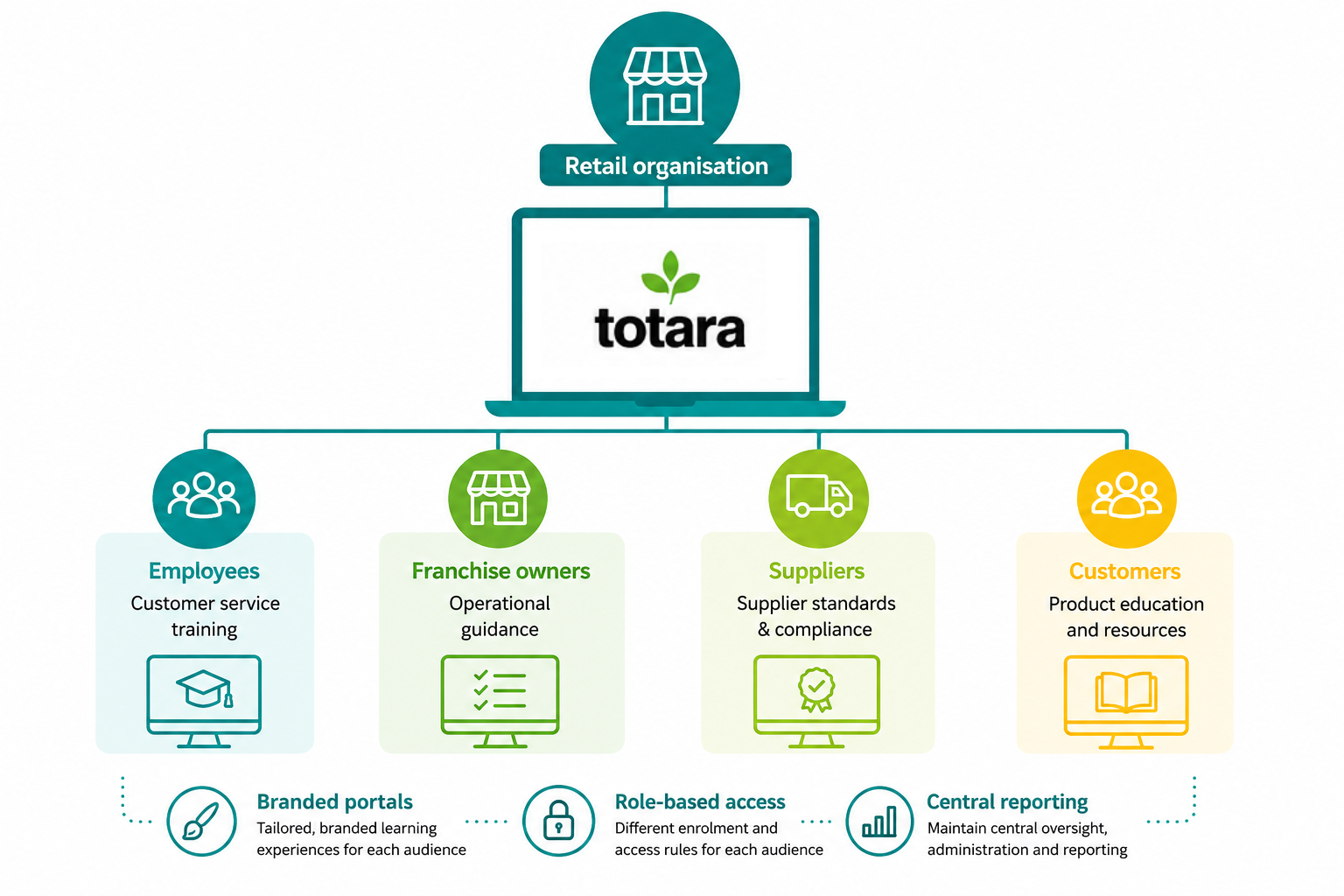
In comparison, extended enterprise training is more complex, as it needs to serve multiple audiences, each with different training needs. Customers might need product training, while your sales network requires partner enablement and compliance learning to ensure consistency across your wider organisation. As well as the varied content and delivery mechanisms, these different audiences can also require distinct branding, enrolment and access rules, and reporting.
An extended enterprise LMS built with Totara is equipped to address this complexity, using features such as multitenancy to deliver tailored, branded learning experiences for external audiences while maintaining central oversight, administration and reporting.
Where is extended enterprise training used?
In practice, extended enterprise learning is used for five common audiences and use cases.
Customer education
Customer training supports product adoption and customer onboarding, allowing users to quickly and independently get up to speed. Salesforce research found that 61% of customers prefer to use self-service resources to resolve simple issues. Well-designed customer training provides structured guidance, allowing customers to navigate and understand products without relying on your support team.
Partner and channel training
Partners and resellers all need up-to-date product knowledge, sales guidance and brand information in order to do their jobs effectively. When done right, partner training ensures that external representatives are aligned with your core messaging, and better able to recommend the right solutions.
For example, Samsung’s Totara-based Backstage platform demonstrates the commercial potential of effective channel training, helping third-party retail staff build their product knowledge and represent the Samsung brand more effectively.
Supplier and vendor training
Supplier and vendor training helps third parties understand your organisation’s quality standards, operational procedures, security requirements, and more. This training is essential for ensuring that your standards are upheld across your extended organisation.
Extended workforce training
Contractors, freelancers, temporary workers and distributed teams typically need rapid access to onboarding, health and safety information, systems training and role-specific resources. A central platform can provide this without giving external learners unnecessary access to internal systems or content.
Compliance and regulatory training
In addition to your core compliance training obligations, it may be necessary to demonstrate compliance across partner organisations or subcontractors. An extended enterprise training platform allows you to demonstrate that third parties hold the required certifications with consistent assignments and assessments, backed by verifiable audit trails and reporting.
Why does extended enterprise training matter for organisations?
An organisation’s external audiences have a significant impact on the customer experience, as well as its reputation, brand image, and revenue growth. Salesforce research found that 80% of customers say that the experience a company provides is just as important as their products and services.
Extended enterprise training can play an important role in shaping that experience, ensuring the entire network delivers sales and support experiences aligned with the organisation’s values.
A strong extended enterprise learning strategy can support:
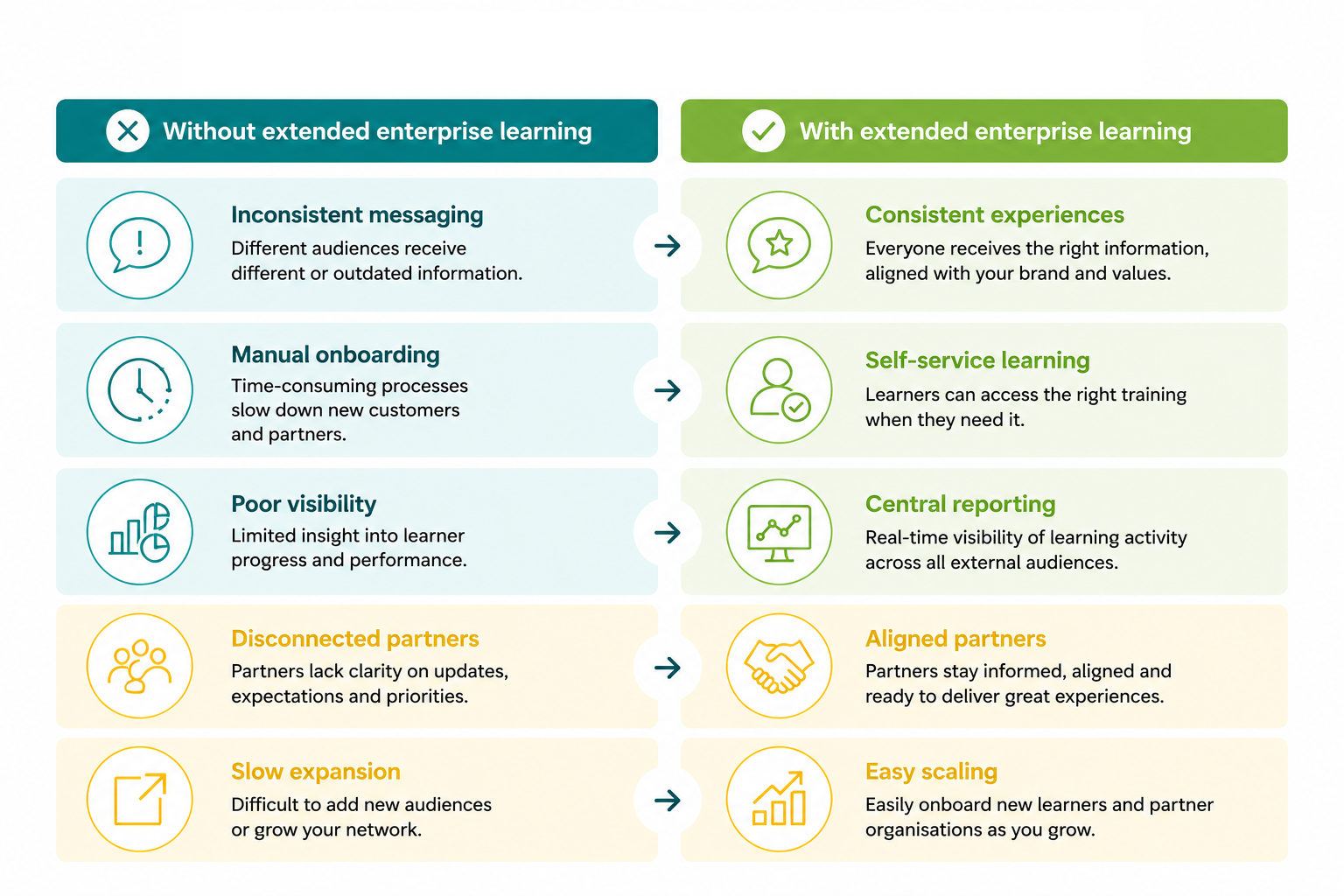
Revenue growth: Well-informed customers are more likely to get more out of their products, while capable partners can support them and sell more effectively
Customer retention: Useful onboarding and product education reduce the friction experienced by customers, improving long-term adoption and customer loyalty
Partner alignment: Centralised training helps to ensure that partners are always informed about product updates, brand expectations, and strategic priorities
Consistency: Standardised learning delivered through your own central platform ensures alignment in messaging and service delivery
Operational efficiency: Self-service learning, centralised reporting and automatic enrolments minimise manual admin tasks, as well as the burden on your support team
Scalability: A connected learning platform enables you to add new learners or partner organisations easily, without setting up new infrastructure each time
When learning is relevant to each external audience’s goals, context, and working relationship, it is more likely to drive engagement, influence behaviour and deliver measurable value for both learners and the organisation.
How to build an extended enterprise learning strategy
1. Define the business objectives
Start by setting out what you’re hoping to achieve with your strategy. Are you trying to improve product adoption, reduce the demand for your support services, improve sales partner performance, or create a new training revenue stream?
A set of clearly defined objectives will guide you when making decisions about your content and how it’s delivered, as well as how you measure success and demonstrate value to other stakeholders.
2. Identify your target audiences
The key with extended enterprise training is that it serves different external audiences with unique requirements and desired outcomes. The next step is to map out every external group that requires training and define their relationship with your organisation.
Consider what each group needs to know, how they will access your platform, who owns the relationship internally, and whether you need to assign delegated control for local administrators.
3. Assess learning needs and barriers
Next you need to understand the specific learning requirements of each audience. Start by reviewing known knowledge gaps, support data, learner feedback, and relevant compliance data. It’s also important to speak to the teams that deal directly with these audiences, as they can provide deeper insight into the challenges they face.
You should also consider practical factors that can affect external audiences, such as low-connectivity work environments, limited time for training, or language barriers. Identifying these challenges early allows you to take a more pragmatic approach to your training design.
This principle is demonstrated by Save the Children, which uses Totara to deliver face-to-face and online learning to 20,000 staff across the world, including teams in remote locations with unreliable internet access and other logistical challenges.
4. Choose the right extended enterprise LMS
When selecting your learning platform, you need to confirm that it supports the complexity you require today, and the scale you’ll need going forward. The exact requirements will depend on your strategy, but typical functional requirements include:
- Multi-tenancy for separation of users and content
- Custom branding for individual tenants and portals
- Flexible authentication and enrolment to suit different user groups
- Automated assignments to minimise manual administration
- Certification management for tracking ecosystem-wide completion and compliance
- Delegated administration for user audiences
- Granular, audience-specific reporting
Additionally, the selection process needs to account for accessibility, ease of use, data security, and any integrations you may require.
5. Design relevant learning experiences
Next, you need to determine how best to deliver learning to each of your audiences. Whereas product updates might be effective as short videos and knowledge checks, certifications may require structured programmes, formal assessments and recurring training.
Depending on each audience’s requirements and goals, training programmes might contain self-paced learning, synchronous virtual or in-person sessions, social discussions and searchable resources. Learner journeys should be kept clear and deliberate, ensuring that learners only access what’s important to them.
6. Establish meaningful measures of success
Completion rates are a useful measure, but they’re just one piece of the puzzle. You need to identify a broader set of metrics which you’ll use to evaluate the success of your learning platform and wider strategy. This can include:
- Product usage and adoption
- Certification status
- Support ticket volume
- Partner sales
- Customer satisfaction
By establishing these baselines before launching your platform, you can credibly assess the impact of your extended enterprise implementation.
7. Launch, support and improve
A successful launch is only the first step of a longer-term programme. Starting with a priority audience, validate the experience by testing thoroughly from the learner perspective. Make sure it’s easy to access the system, find support, and understand what to do next in order to minimise friction for your external audiences.
Use learning data and feedback from across the business to continuously improve the programme and adapt to evolving requirements.
The role of technology in extended enterprise learning
Bring internal and external learning together
Managing both internal and external learning on a single platform reduces the duplication of systems and administration, while also providing more consistent learner experiences. However, this doesn’t mean giving each learner audience identical content.
Totara’s multitenancy functionality allows organisations to create separate learning environments within a single platform for employees, customers, partners, and other audiences. Each portal can have distinct branding, content, and access rules, while site-level admins have oversight and platform-wide reporting.
Financial technology company Bravura Solutions, for example, consolidated its employee and client learning within a single Totara platform, allowing it to deliver product-specific customer training alongside internal employee development.
Automate training delivery and reduce administration
Extended enterprise learning often means training greater numbers of learners across multiple organisations and delivering a wider range of learning content. Compared to in-house employee development, the administrative burden can quickly make this difficult to maintain. In Totara, admins can use dynamic audience rules to assign relevant and required learning. Automated onboarding and account creation ensure learners are added to the correct tenant, while reminders and recurring assignments or certifications help ensure that audiences receive the right training at the right time.
LMS integrations provide additional opportunities for automation by connecting Totara with CRMs, identity management systems, e-commerce platforms, and other business systems. This allows data to flow seamlessly between platforms, reducing the need to manually synchronise data across your technology stack. For example, a new customer record could trigger access to onboarding training, while completion data could be automatically shared with external reporting tools for further analysis.
Strengthen compliance, reporting and accountability
Using the right technology also provides your organisation with greater visibility of how training is being delivered beyond your immediate workforce. Rather than relying on third parties to maintain and share separate training records, organisations can monitor key compliance metrics through Totara’s centralised reporting functionality.
Totara’s reporting engine allows your team to monitor completions, assessment results, engagement, and certification status across your internal and external audiences. In addition to supporting internal oversight with audit-ready evidence, these features can help you to identify learners or audiences requiring additional support.
Additionally, Totara’s certification functionality allows you to confirm that partners, vendors, or contractors are up to date with their training, with flexible, multi-year recertification paths, expiry tracking, and scheduled reminders. Instead of maintaining complex spreadsheets and chasing third parties to verify compliance, you can check that external audiences have the right credentials at a glance.
Support flexible and engaging learning experiences
For external audiences, training often has to be completed around learners’ full-time roles, across different locations, and using personal devices. Therefore it’s essential that your learning platform supports multiple delivery methods, providing flexible ways to access and complete required learning.
Totara can be used to create carefully curated learning journeys comprising self-paced courses, virtual seminars delivered through integrations with Microsoft Teams or Zoom, practical face-to-face training, structured programmes, mobile learning, as well as offering informal user-generated content. Assistive AI tools can also enhance the learner experience, for example by summarising course content, creating simple knowledge checks, or recommending relevant content.
Adapt the platform to your organisation
Every organisation is unique, so diverse functional requirements and business goals require flexible tools. Totara is highly configurable, meaning you can customise workflows, reports, branding and integrations around your strategy, instead of reshaping your strategy to fit within rigid platform constraints.
As a Totara Platinum partner, Synergy Learning can further extend the platform with custom development, integrations for your other systems, and tailored dashboards and reports.
Conclusion
Extended enterprise learning isn’t just about distributing training to wider audiences. When done right, it is an essential part of your learning strategy that improves the customer experience, strengthens partner performance, supports compliance, and brings consistency across your entire business ecosystem.
It’s important to consider whether your current learning approach gives external audiences the relevant content, accessible experience and ongoing support they need. Totara makes it possible to deliver tailored learning to multiple external audiences while retaining central control.
If you want to see how Totara works as the foundation of your extended enterprise strategy, get in touch with our specialists.