
As AI has become integral in everyday work, organisations need to develop a combination of technical and human skills that enable employees to work effectively alongside AI. For L&D, that means rethinking not only what people learn but how they learn and apply those skills over time.
In this article, we’ll explore the AI skills organisations should be prioritising and how L&D teams can develop them across the workforce.
What are AI skills?
AI skills are the knowledge and capabilities people need to work effectively with AI in their day-to-day roles.
Broadly speaking, these skills fall into two categories. The first is AI literacy and technical skills, such as writing effective prompts, understanding AI’s capabilities and limitations, recognising inaccurate outputs, and using AI responsibly. As AI becomes part of more workplace tools, these skills are becoming increasingly valuable across a wide range of roles.
The second category focuses on the human skills that help people apply AI effectively. Critical thinking, communication, creativity, adaptability and professional judgement all become more important when employees are working alongside AI. While AI can help generate ideas or automate routine tasks, people still need to interpret outputs, and make informed decisions within the context of their organisation and role.
Upskilling an AI-capable workforce means developing both sets of skills together.

Why is there a gap between AI training and AI adoption?
If we look at the numbers, job postings requiring AI skills increased by 2,000% between March and June 2023, yet only 13% of employees reported receiving AI training from their employer. As more organisations introduce AI, many are still figuring out how to help employees use it.
One reason is that AI is often viewed as a technology project rather than a people initiative. While IT teams may lead the rollout of new tools, L&D has an important role to play in helping employees understand how to use them effectively. Other organisations are taking a cautious approach, waiting for AI to mature before investing in training. However, PwC’s Global AI Jobs Barometer 2026 found that the skills required for the most AI-exposed jobs are changing more than twice as fast as those for the least AI-exposed jobs, making it harder to delay workforce development.
Employees need the skills to question AI-generated outputs, understand when human judgement is needed and apply AI appropriately within their role. That’s where L&D can make the biggest difference, by building AI literacy alongside critical thinking and professional judgement.
Expert tip: Build AI skills around how people work
Before designing any AI skills programme, map the workflows first.
The most important guardrail is also the simplest: every employee who uses an AI tool should be able to answer four questions. What can this tool do? What are its known limitations? When does this output require human review before it is acted on or shared? What does our organisation’s policy say about using it?
Organisations also need to think carefully about what AI should not do. AI can accelerate content creation, improve knowledge discovery, reduce administrative load and streamline operational workflows. It cannot understand organisational context, interpret business priorities, build trust with learners or ensure that learning addresses the right performance problem rather than simply generating more content.
The 8 AI skills organisations should prioritise
The skills employers are asking for have shifted considerably in a short period of time. Technical AI skills, including machine learning, data analysis and model evaluation, remain in demand in specialist roles. Alongside them, a broader set of capabilities is now appearing consistently in job postings across sectors: prompt engineering, data literacy, AI ethics, critical thinking and communication. Perhaps the most significant shift is the growing emphasis on judgement and strategic thinking in roles that have not traditionally required them; a direct consequence of AI taking on more of the routine cognitive work those roles previously involved.
Below is a breakdown of the eight AI skills that matter most for a workforce that needs to work effectively with AI.
1. Data literacy
Data literacy is the ability to read, understand, question and communicate with data.
As AI tools increasingly surface data-driven insights and recommendations, employees without basic data literacy will struggle to evaluate what they are being shown. They may accept outputs uncritically or, equally problematic, dismiss them without understanding why they are wrong. Neither response serves the organisation well.
L&D teams can build data literacy incrementally, starting with the data sources employees already encounter in their roles and building up from there. Scenario-based learning works well here, particularly when it puts learners in situations where they have to decide whether a data-driven recommendation is sound before acting on it.
2. Prompt engineering
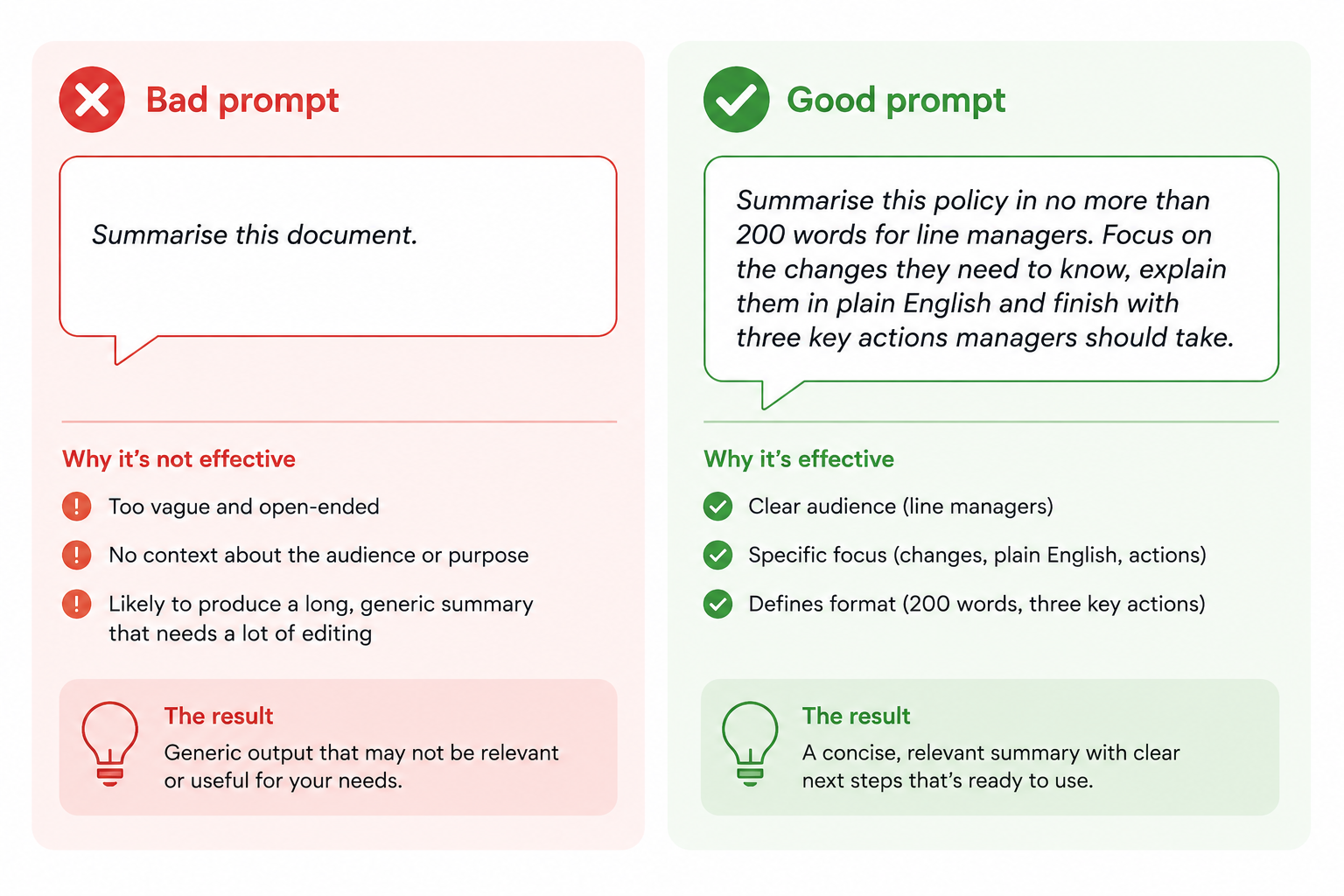
Prompt engineering is the skill of writing clear, well-structured queries that get useful outputs from generative AI tools. It sounds straightforward, but it has a meaningful impact on the quality of what AI produces and, by extension, on how much time employees save or waste.
A well-constructed prompt specifies context, constraints, tone, format and purpose. A poorly constructed one produces generic, off-target or unreliable output that requires significant rework.
3. AI ethics
AI ethics covers the principles and practices that govern responsible AI use: fairness, transparency, privacy, accountability and the protection of individual rights. For employees, this translates into practical questions they need to be able to answer in their own roles.
What data am I putting into this tool, and does our privacy policy permit that? Is this output potentially biased, and what harm could that cause? Who is accountable when an AI-assisted decision turns out to be wrong? Is this use of AI consistent with our values and our obligations to the people affected by it?
4. Critical thinking
Critical thinking is the ability to evaluate information objectively, identify assumptions, assess evidence, and reach well-reasoned conclusions.
Generative AI can produce plausible-sounding content that is factually incorrect or subtly misleading. Employees who accept AI outputs without scrutiny create real risk for their organisations, whether that is a manager acting on a flawed performance analysis, a communicator publishing inaccurate content, or an L&D professional deploying a course built on incorrect information.
5. Developing a growth mindset
A growth mindset is the belief that capabilities can be developed through effort and learning. In the context of AI adoption, it matters for a specific reason: the skills required for AI-exposed roles are changing faster than any static training programme can address. Employees who approach that pace of change with curiosity rather than anxiety are far more likely to keep developing than those who experience it as a threat.
L&D leaders can support this directly by designing learning experiences that normalise not knowing, reward experimentation and make it safe to make mistakes while practising new skills. AI-powered roleplay and simulation environments are particularly well-suited to this because they allow learners to practise difficult or unfamiliar tasks in a low-stakes setting before applying them in real situations.
For example, a new manager can rehearse giving constructive feedback to an AI-powered employee, while a customer service adviser can practise handling a difficult conversation. The AI responds naturally throughout the interaction before providing structured feedback, helping learners build confidence and refine their approach before applying those skills in the workplace.
6. Creativity
Creativity is one of the capabilities that AI adoption consistently elevates rather than replaces. AI can generate options, suggest combinations, surface patterns and accelerate iteration. It cannot originate ideas that are genuinely novel, contextually appropriate and aligned with the specific needs of the organisation or the customer.
For L&D professionals, this is particularly relevant. AI tools can help create content at scale, but the judgement about what learning experience will work for a specific audience, in a specific organisational context, to address a specific performance gap, requires human creativity and professional knowledge.
Building creativity as a workforce capability means creating space for it. That involves protecting time for reflective practice and encouraging employees to experiment with AI tools as creative aids rather than replacements for thinking.
7. Communication
As AI takes over more routine drafting, summarising and formatting tasks, the human contribution to communication shifts towards the things AI cannot do well: reading the room, understanding the emotional context of a message, navigating organisational politics, and building relationships.
8. Emotional intelligence
Emotional intelligence, the ability to recognise, understand and manage one’s own emotions and those of others, is another capability that AI adoption makes more valuable. The more routine cognitive work AI handles, the more visible the distinctively human moments become: difficult conversations, leadership under pressure, trust-building, empathy in customer or colleague interactions.
AI-exposed junior roles are now seven times more likely to require leadership and strategic thinking, according to PwC’s Global AI Jobs Barometer 2026. Much of what we mean by leadership in practice is emotional intelligence applied in context: knowing when to challenge, when to support, how to motivate, how to handle uncertainty and how to bring people with you through change. These capabilities cannot be automated, and they are not developed through information transfer alone.
Which AI skills should be prioritised for different industries?
| Industry | Priority AI skills | Human capabilities to protect |
| Healthcare and social care | Data literacy, AI ethics, critical thinking, AI literacy, prompt engineering | Clinical judgement, empathy, patient communication |
| Financial services | Data literacy, AI literacy, AI ethics, prompt engineering, critical evaluation of AI outputs | Regulatory judgement, client relationships, trust, risk assessment, decision-making |
| Education and L&D | Prompt engineering, AI ethics, data literacy, deep learning awareness | Learning design, contextual knowledge, facilitation, coaching, creativity |
| Manufacturing and logistics | Data literacy, machine learning awareness, growth mindset | Operational judgement, safety awareness, team leadership, problem-solving, adaptability |
| Retail and customer-facing roles | Prompt engineering, AI literacy, data literacy, AI ethics, critical evaluation of AI outputs | Customer relationships, empathy, problem-solving, communication, brand judgement |
How to help employees leverage AI skills for career advancement
There are several practical things organisations can do to support this.
Make AI skills visible in skills frameworks and career pathways
If AI literacy does not appear in job profiles, progression frameworks or performance conversations, employees have no way to understand its career relevance or measure their own development against it.
Design learning experiences that build on each other
A single AI awareness session develops awareness. A sequence of experiences that builds from awareness to application to critical evaluation to governance, with practice opportunities at each stage, develops genuine capability. Tools that support personalised learning pathways, including AI-assisted content discovery and skills-based recommendations, help employees move through that sequence at a pace that works for their role and their current capability level.
This shift is explored in our webinar, From Consumers to Creators: Empowering Learners with AI in Totara, which shows how AI-powered tools can help organisations move beyond one-off training by enabling employees to create, share and continuously improve knowledge together.
Create opportunities for employees to apply AI skills in real work
Supervised experimentation, peer learning groups, internal communities of practice and structured reflection all help people move from training to capability.
Identify AI champions within teams
Find employees who are already curious about AI and give them a recognised role in supporting adoption across their teams. AI champions do not need to be technical specialists. Their value lies in sharing practical examples, helping colleagues build confidence and connecting team-level needs with L&D and IT.
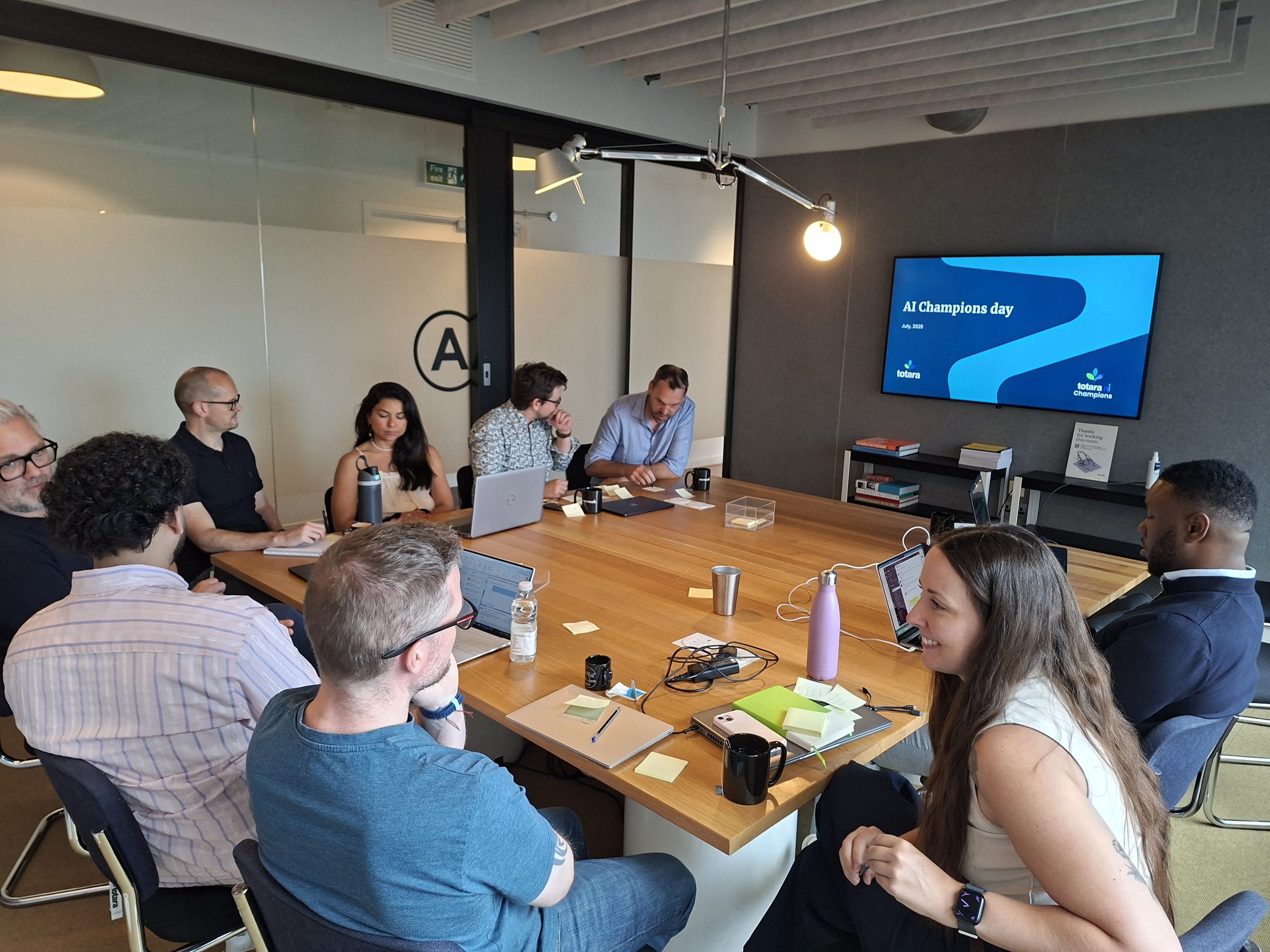
AI Champions Day at Totara
At Totara, we’ve introduced AI Champions across our commercial teams. We’re giving employees with an interest in AI the opportunity to help identify where AI can deliver real value and share their learning with colleagues. Champions also come together regularly to exchange ideas, discuss what’s working and feed insights back into our wider AI strategy.
Create communities where people can learn together
The Totara Community brings together learning professionals from around the world to exchange ideas, discuss emerging trends and learn from one another. Members can join expert-led webinars covering topics such as AI, build their skills through Totara Academy, connect with peers tackling similar challenges and share product feedback. As AI continues to evolve, communities like this help learning professionals stay informed, share practical experiences and continuously develop their skills.
Preparing people for an AI-first workplace
As AI becomes part of everyday work, it’s easy to focus on the technology. But successful AI adoption has always been about people. AI works best when it supports learning and performance, rather than replacing human expertise.
The organisations that will build genuinely AI-ready workforces are those that treat AI skills as a long-term strategic investment. That means embedding AI into learning and development, providing opportunities to practise and apply new skills, establishing clear governance, and recognising where human expertise remains essential.
Want to explore these ideas further? Read our L&D guide to AI: Conversations from the Field, where learning leaders share practical insights on developing AI capability, supporting workforce adoption, creating a culture of continuous learning, and helping L&D teams lead AI with safety and confidence.
Frequently asked questions
What is the difference between AI literacy and AI skills?
Do all employees need technical AI skills?
How quickly are AI skill requirements changing?
How should L&D leaders get started with AI skills programmes?
What role does L&D play in building AI readiness?
L&D’s role is shifting from course creator to learning orchestrator. That means combining AI tools with instructional design expertise, organisational knowledge and business context to deliver learning experiences that genuinely develop capability. It also means L&D teams developing their own AI skills, including an understanding of AI agents, workflow design, data literacy and governance, so they can make informed decisions about where AI adds value.
If you are working through how to build AI capability across your organisation, or how to equip your L&D team to lead that work, get in touch with the Totara team to explore how our platform supports skills development, personalised learning and AI-assisted content creation at scale.